
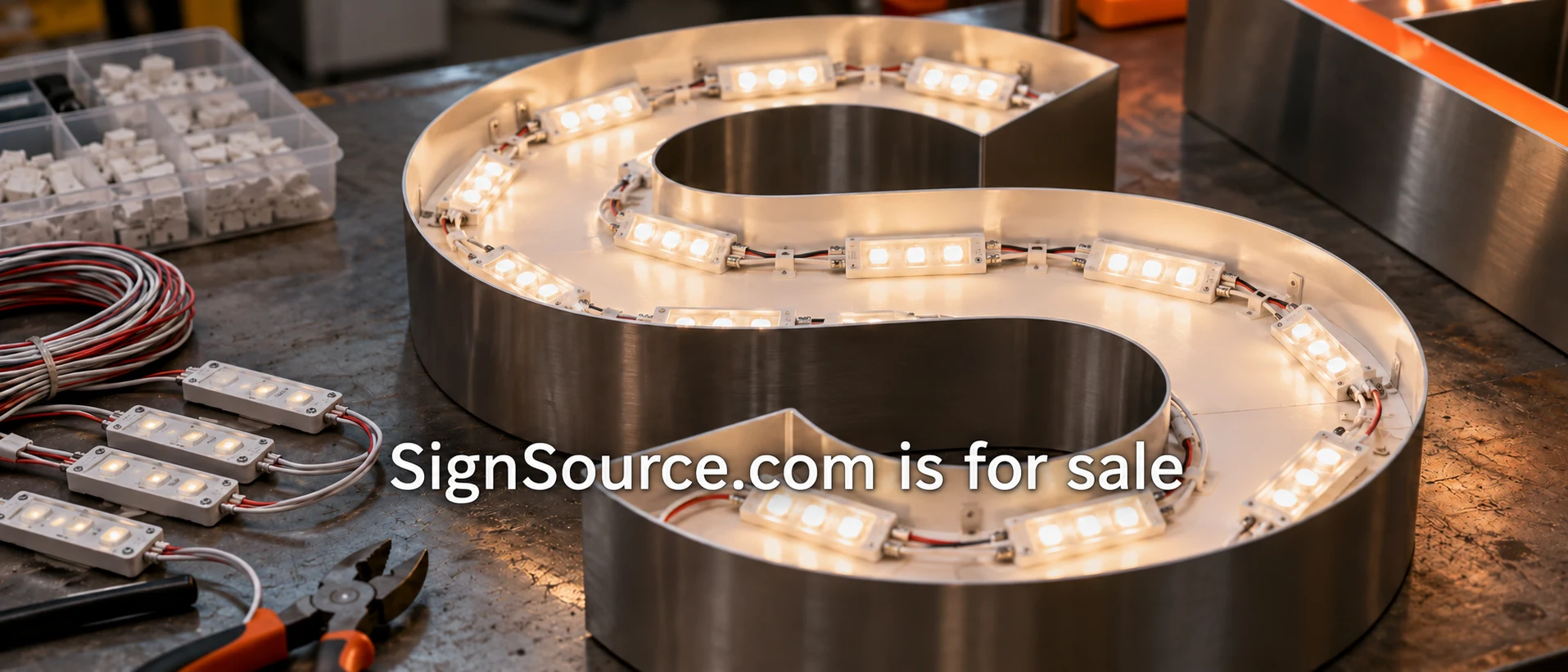
Wholesale LED modules are best specified as a lighting system, not as a bag price. The letter stroke, return depth, face material, desired luminance, module optics, voltage, wiring layout, and power supply loading all interact. A shop that records those inputs can repeat a good result. A shop that chooses by module count alone may discover hot spots, dark corners, visible color differences, or a supply running too close to its limit.
Start with the letter geometry
Record the narrowest stroke, widest stroke, average can depth, return color, face material, and trim condition. Deep red letters with narrow strokes behave differently from broad white letters. A shallow can gives light less distance to blend. A dark interior absorbs light that a white interior would reflect. The manufacturer’s SloanLED density guidelines are useful because they connect product families with depth, stroke, and spacing rather than presenting one universal modules-per-foot number.
Measure representative letters, including the awkward ones. A capital I may need a different path from a broad M. Curves, tight corners, and internal obstructions can change spacing. Note where leads cross metal edges, where pass-throughs need protection, and where a module cannot sit flat. A scaled layout or full-size pattern lets the estimator count chains and supplies before production begins.
Read beam angle as coverage
Beam angle describes how light spreads from the optic. A wider beam can improve blending in a shallow return, but the complete result still depends on spacing, face diffusion, module output, and reflective surfaces. Narrow optics can project farther in deeper cans. Product guidance from Principal Sloan guidance helps shops understand optical and application tradeoffs. Treat the published angle as an input to a tested layout, not a promise that any spacing will work.
A simple test box is valuable. Build it with the intended depth, interior finish, face grade, trim, and representative module pattern. Photograph the face at a fixed exposure, but also inspect it with the eye at normal viewing distance. Cameras can exaggerate or hide banding. Test dimmed and full conditions when controls are involved. Keep the approved sample or a complete record so production does not drift after the first order.
Choose voltage and wiring deliberately
Most common sign modules use constant-voltage systems, often 12V or 24V. The selected family determines supply choice, maximum chain guidance, conductor sizing considerations, and voltage-drop planning. A longer run can show dimming at the far end if the layout ignores conductor length and load. Follow the module and supply instructions for feed arrangement, polarity, connectors, environmental protection, and limits. The catalog from Allanson LED modules illustrates the variety of formats that can sit inside the general category.
Map circuits on the pattern. Mark each supply, branch, chain direction, splice, pass-through, and service location. Keep connections accessible and protected for the environment. Separate primary and secondary routing as required by the listed system and applicable rules. A tidy layout saves troubleshooting time because a technician can compare the installed sign with the production record instead of tracing an undocumented chain.
Size the power supply with headroom
Add the actual module wattage on each planned circuit, then apply the manufacturer’s loading limit and required headroom. Do not divide only by the wattage printed in the supply name. Temperature, enclosure, input conditions, derating, and listing instructions can affect usable capacity. The product resources at Mean Well show why a supply must be selected by model data, environment, and application rather than brand familiarity alone.
A good bill of materials states module model and color, modules per letter, chain count, supply model, loading per supply, conductor and connector choices, and mounting accessories. It also records the revision of the manufacturer guidance used. If a substitute is proposed, rerun the density, wattage, optic, depth, and compatibility review. “Equivalent” should mean the lighting and electrical system still meets the approved basis.
Control color and production variation
Order enough modules from a consistent production group when color uniformity is critical, and follow supplier guidance on binning. Mixes that look close on a bench can become visible across a large elevation. Face stock and translucent overlays also affect perceived color. Label cartons by job and keep leftovers identified. A replacement years later may need an expectation-setting conversation because LED output and color can shift over time.
Production checks should include adhesion surface preparation, mechanical retention where required, connector seating, polarity, supply loading, grounding and bonding work, wire protection, and illumination behind the actual face. Record current or load observations if the shop’s procedure calls for them. Photograph the open letter and illuminated face. The record gives service staff a useful starting point when a future call reports one dark section.
Keep a dated sample, layout drawing, loading calculation, and receiving record together so the next production run begins from verified work.
Thermal conditions deserve their own review. A supply or module operated in a hot enclosed space may not perform like the same component on an open bench. Dark returns, sun exposure, limited air volume, and supply placement can raise temperature. Check published operating limits and derating information, then keep heat-producing components apart when instructions allow. Temperature observations in the test assembly can expose a layout that meets the wattage calculation but creates a poor operating environment.
A repeatable wholesale spec
The purchase order should carry more than quantity. Include the exact module and supply models, voltage, color temperature or color, package requirements, acceptable substitutions, and documentation needs. Receiving should verify labels and visible condition before parts reach production. Stock rotation matters for adhesives and other date-sensitive components. Store modules within published temperature and environmental limits.
The final specification is a chain of decisions: geometry establishes the lighting problem, optics and density establish coverage, face material establishes diffusion, wiring establishes delivery, and the supply establishes safe capacity. A density guide and test box turn those decisions into a shop standard. Review the standard whenever depth, face, module family, finish, or supply changes. That is how wholesale LED modules become a controlled production material rather than a recurring experiment.