
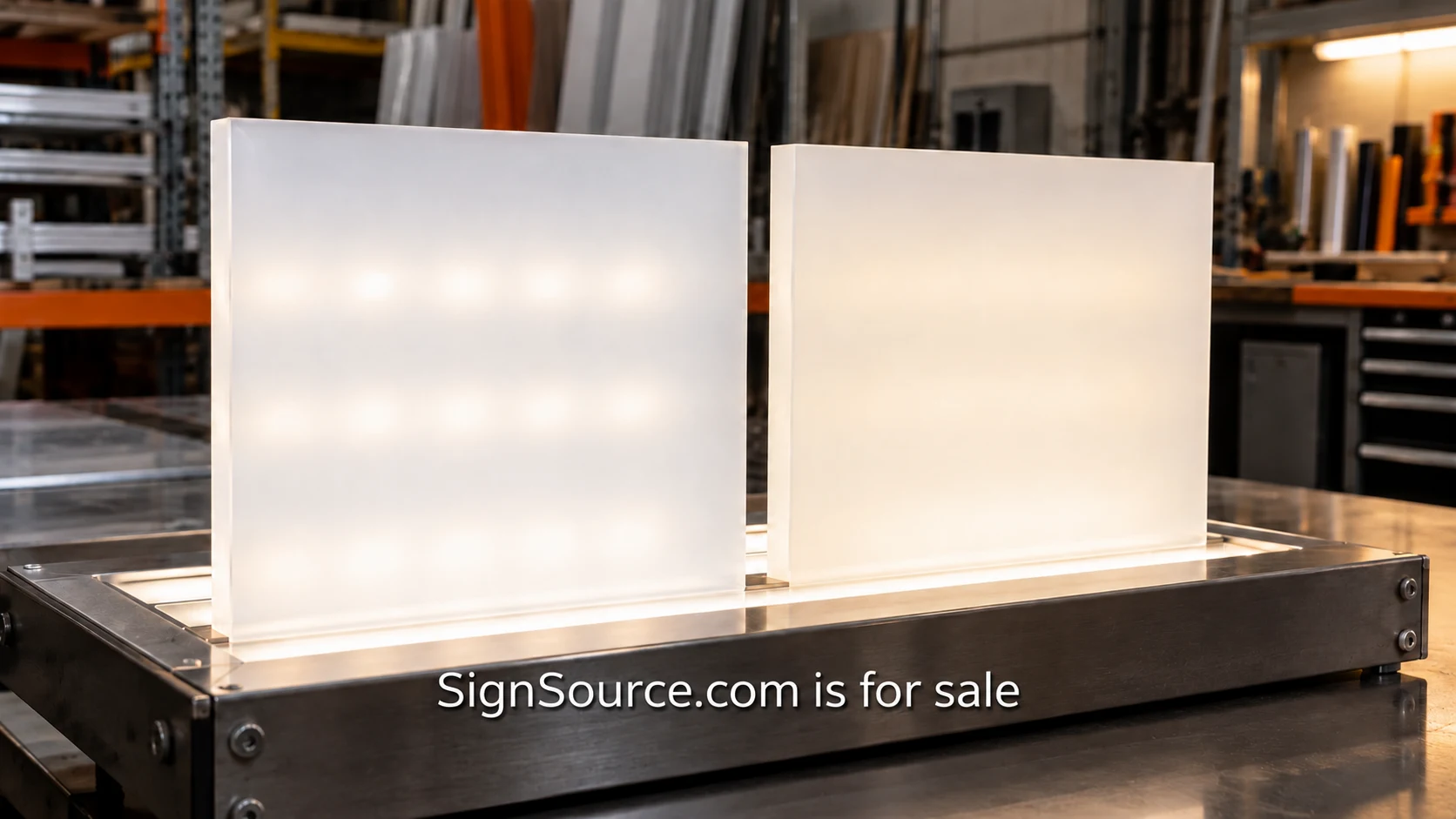
Choosing between 7328 and 2447 white acrylic faces is a lighting decision as much as a material order. Both grades are familiar in illuminated signs, yet they transmit and diffuse light differently. The right selection depends on cabinet or letter depth, lamp or LED spacing, desired brightness, face size, viewing distance, applied film, and the shop’s forming and retention method. A grade number alone does not settle the complete face specification.
Understand the practical difference
White 2447 acrylic is commonly sold as a more light-transmitting sign sheet than 7328. That extra transmission can produce a brighter face from the same light source, but it may also reveal uneven module spacing or shallow construction more readily. A product page for white 2447 acrylic from ShapesPlastics provides one public reference for the material. Always verify the current manufacturer data for the sheet being purchased.
White 7328 is often chosen when stronger diffusion is useful. It can soften the appearance of individual light sources and may suit a cabinet or letter where depth and spacing leave little margin. The 3/16-inch 7328 acrylic listing from eStreet Plastics shows a common sign-face thickness and grade combination. Supplier descriptions are helpful for ordering, while the shop’s own illuminated sample confirms performance in the intended assembly.
Specify actual thickness
“Three-sixteenths” is common shop language, but purchasing and drawings should state the nominal or actual thickness supported by the selected product data. Retainers, trim, forming tools, letter cans, and large unsupported areas respond to thickness. A thin face may flex or pull differently. A thicker sheet adds stiffness and weight, changes forming behavior, and may not fit an existing trim system. Measure replacement material and the retention channel before ordering.
Sheet process also matters. Cast and extruded acrylic can behave differently in fabrication and thermoforming. The broad white sheet selection from Acme Plastics illustrates why color, process, thickness, finish, and cut size belong together on a purchase record. Do not substitute a general white sheet for a documented sign grade based only on appearance under room light.
Control hot spots as a system
A hot spot appears when the face reveals the position or pattern of the light source. The fix may involve face diffusion, increased depth, closer or more even module spacing, a wider optic, lower-output modules at greater density, a reflective interior, or a diffuser. Changing to 7328 can help in some assemblies, but it should not hide a poor layout that creates dark borders, bright centers, or inconsistent strokes.
Build a representative test box at the shallowest expected depth. Use the intended return color, modules, spacing, wire shadows, face grade, trim, and overlay. Include a seam or support if the final sign has one. View the sample head-on and from expected angles. Check it in a dark shop and in ambient light. A face that looks smooth at night may appear gray or dull during the day if transmission is too low for the design.
Photographs help compare versions when exposure and white balance remain fixed. They are not a substitute for direct viewing. Phone cameras process highlights, lift shadows, and can make banding look better or worse. Mark each test with grade, thickness, depth, module model, spacing, supply voltage, and film. Without those labels, a successful sample becomes an anecdote instead of a repeatable shop standard.
Account for film and color
Translucent vinyl, printed layers, paint, and second-surface treatments change both transmission and diffusion. A white face selected for bare performance may become too dim after a dark overlay. Conversely, a high-transmission face can help recover brightness lost through film while requiring closer attention to module blending. Test the full color build. Small swatches under a single lamp do not reveal large-area uniformity or border effects.
Colored acrylic introduces another set of spectral and availability questions. The LED color and face color must work together. White LEDs behind a saturated face may not produce the expected hue, and a replacement sheet from a different lot or maker may differ from weathered existing faces. For repair work, compare samples at the site and set expectations about matching aged material. The general acrylic information at ePlastics also helps distinguish sheet categories before a sign-specific selection.
Fabrication and handling
Keep masking on through appropriate fabrication steps, support sheets during storage, and avoid concentrated stresses at fasteners or corners. Follow the sheet manufacturer’s recommendations for cutting, drilling, cleaning, cementing, and forming. Improper cleaners can craze acrylic. Flame polishing and heat work require trained technique. A beautiful illuminated result can still fail early if holes, edges, bends, or cleaners introduce stress.
For pan faces, document draw depth, flange dimensions, corner radii, trim allowance, and orientation. Forming changes local thickness, which can affect stiffness and appearance. Large faces need consideration of thermal movement, wind pressure, retention, and access. Those are assembly questions that may call for engineered details. The material choice should enter that review, not stand apart from it.
Receiving inspection should compare the sheet label with the purchase order before masking is removed. Confirm grade, color, thickness, dimensions, quantity, and visible shipping condition. Keep lot information when matching across several faces matters. A mislabeled rack location can send a clear-looking white sheet into production and reveal the error only after illumination. Simple material identification at receiving is cheaper than remaking formed and decorated faces.
Write a complete face callout
A useful callout includes manufacturer or approved basis, grade, color, sheet process where relevant, nominal thickness, finish, face shape, forming requirements, overlay system, retention method, and matching expectation. Add the illumination basis and approved sample reference. For a replacement, include verified dimensions, trim condition, existing depth, and whether the remaining lighting will be serviced before the new face is installed.
The 7328-versus-2447 choice becomes straightforward when the shop tests the complete system. Select 2447 when added transmission serves the brightness target and the lighting layout blends cleanly. Select 7328 when stronger diffusion suits the assembly and the available output can meet the target. Confirm either choice with current product data and a representative illuminated test. The best face is the one that performs in the actual cabinet or letter, not the one with the more familiar number.